
Generative AI Search 101: How AI-Powered Search Works
Learn how generative AI is transforming search from keyword-matching to conversational answers. This guide breaks down how LLM-powered engines like Google’s AI Overviews and Perplexity work—and what it takes to optimise your content for visibility in this new era of AI-driven discovery.
For two decades, the rules of online visibility were dictated by search engines that relied on a complex but understandable system of keywords and backlinks. Now, a new intelligence is rewriting those rules. The rise of generative AI is not just another tech trend; it's a fundamental reimagining of how we find information. Search is becoming a conversation, and the brands that learn to speak the new language will be the ones that thrive.
This transformation is powered by Large Language Models (LLMs), the same technology behind tools like ChatGPT. Instead of just pointing you to a list of websites, generative search engines like Google’s AI Overviews (formerly Search Generative Experience or SGE) and Perplexity AI aim to understand your question and provide a direct, synthesized answer. This marks the dawn of a new discipline: Generative Engine Optimization (GEO), a crucial subset of the broader practice of AI Optimization (AIO). Understanding this new frontier, specifically LLM Optimization (LLM SEO), is no longer optional—it's essential for survival and growth.
This guide will take you through the core mechanics of AI-powered search, explain the principles of LLM Optimization, and reveal how the timeless art of digital PR has become more critical than ever in building visibility in this new era.
From Blue Links to Direct Answers: The New Search Paradigm
To grasp the magnitude of this change, we must first understand the difference between the old and the new.
How Traditional Search Works
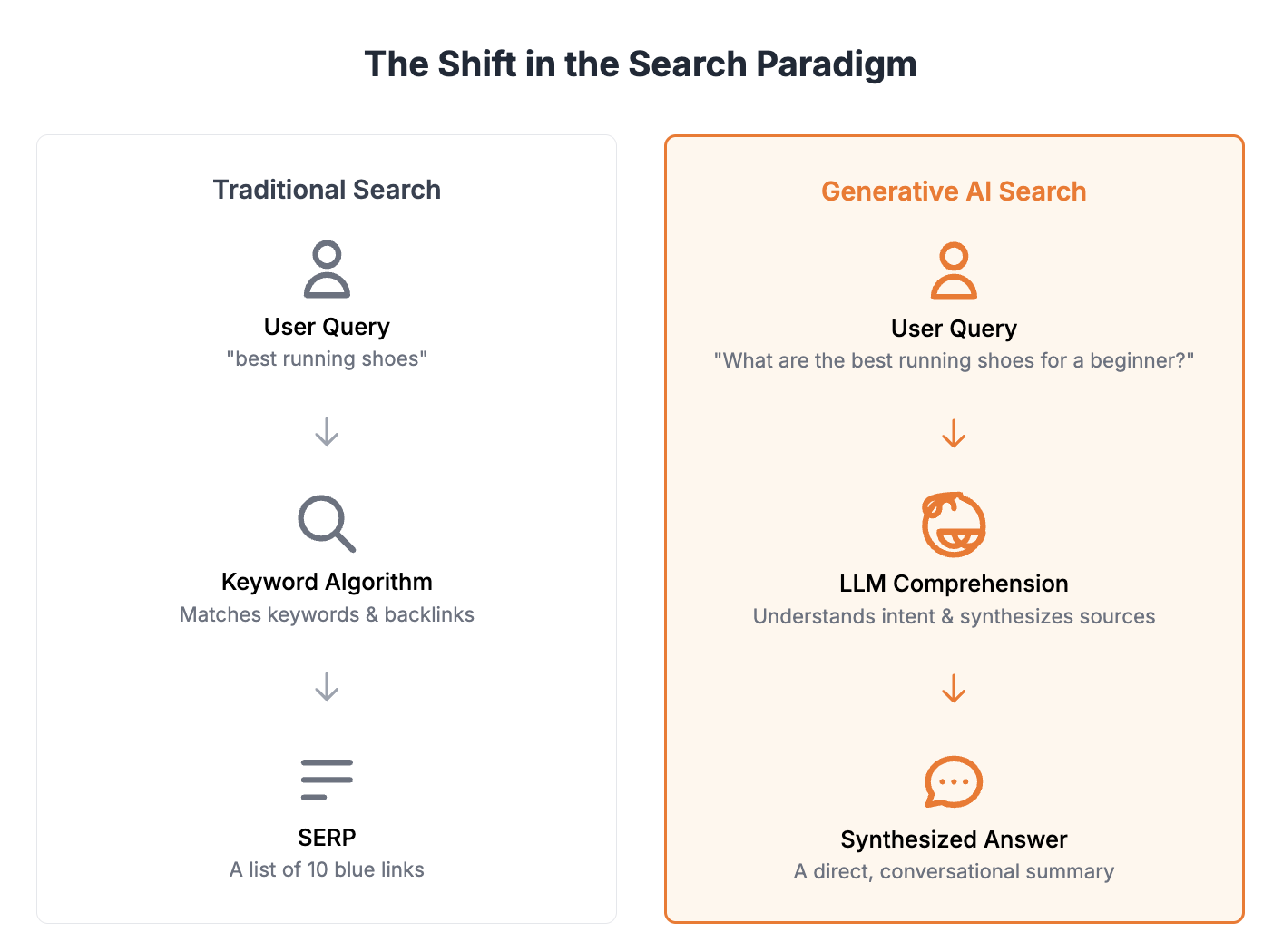
For years, search engines have operated like an infinitely large, meticulously organized library index. When you typed a query, the engine’s crawlers would scan their index of trillions of web pages for the keywords in your search. They would then use a sophisticated algorithm, with hundreds of ranking factors like site speed, mobile-friendliness, and crucially, the number and quality of backlinks, to determine which pages were most relevant and authoritative. The end result was the familiar Search Engine Results Page (SERP)—a list of ten blue links. The entire discipline of Search Engine Optimization (SEO) was built around getting your page as high up on that list as possible.
How Generative AI Search Works
Generative AI search operates on a completely different principle: comprehension. It doesn't just match keywords; it seeks to understand the intent and context behind your query. When you ask a question, the process looks something like this:
Understanding the Query: The LLM first analyzes your question, using its vast training to grasp nuances, context, and the underlying information you’re seeking. It understands that "best places for a family holiday in Spain" requires more than a list of cities; it requires considerations like safety, activities for children, and budget-friendliness.
Retrieval-Augmented Generation (RAG): This is a critical step. The AI doesn't just "know" the answer from its training data, which can be outdated. Instead, it performs a real-time search across a curated set of trusted web pages, academic papers, and other reliable sources. This is the "Retrieval" part.
Synthesis and Generation: The AI then takes the information it has retrieved from multiple sources, evaluates their credibility, synthesizes the key points, and generates a brand-new, conversational answer. This is the "Generation" part. It presents this summary directly to you, often with citations or links to the sources it used, allowing you to explore topics in more depth.
The result is no longer a list of potential answers but a direct answer. This fundamentally changes the user's journey and, therefore, the goal of optimization. The new goal isn't just to be on the list; it's to be the source that informs the AI's answer.
LLM Optimization (LLMO): The New Rules of Visibility
If traditional SEO was about optimizing for a keyword-based algorithm, LLM Optimization (LLMO), or Generative Engine Optimization (GEO), is about optimizing for an AI's understanding. It’s about making your content not just discoverable, but citable. It requires a shift in mindset from keywords and links to concepts, entities, and authority.
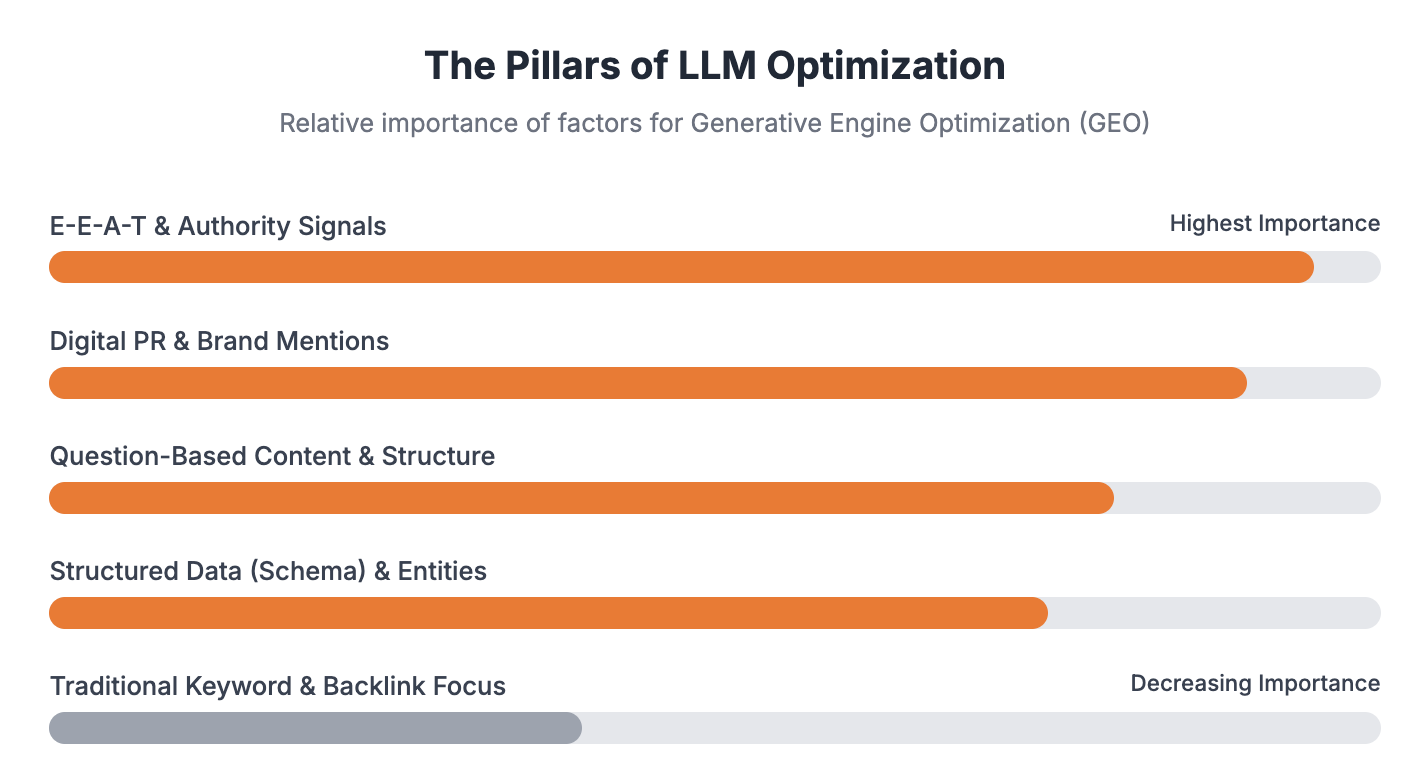
While some principles of traditional SEO remain vital—a technically sound, fast, and secure website is still table stakes—LLMO introduces new priorities. Here is a comparison of the old versus the new.
Actionable Strategies for LLM Optimization
Optimizing for generative AI requires a deliberate and nuanced approach to your content and overall digital presence.
1. Embrace Conversational, Question-Based Content
Think about how people ask questions. They don't speak in keywords; they ask full questions. Your content strategy must reflect this.
Answer the Public: Create content that directly answers the "who, what, when, where, why, and how" questions your audience is asking. Use clear, declarative sentences. For example, instead of just targeting the keyword "best running shoes," create a heading that asks "What Are the Best Running Shoes for Beginners?" and answer it directly in the first paragraph.
Structure for Extraction: Use clear headings (H1, H2, H3), bullet points, and numbered lists. This makes it incredibly easy for an AI to parse your content, extract key information, and repurpose it in a summary. FAQ sections are goldmines for LLM optimization.
2. Double Down on E-E-A-T
E-E-A-T (Experience, Expertise, Authoritativeness, and Trustworthiness) was already a cornerstone of modern SEO, but for LLMs, it is the absolute foundation. AI models are designed to fight misinformation, so they actively seek signals of credibility.
Demonstrate Expertise: Showcase author credentials, link to original research, and provide clear, well-supported arguments.
Build Trust: Have a clear "About Us" page, easy-to-find contact information, and transparent privacy policies. Customer reviews and testimonials also contribute to trust signals.
3. Master Structured Data and Entities
This is where the technical side of LLMO becomes crucial.
Schema Markup: Structured data, or Schema markup, is code that you add to your website to help search engines understand the context of your content. By using Schema for things like articles, products, events, and organizations, you are essentially spoon-feeding the AI with clear, organized information about who you are and what you do.
Entity Optimization: An "entity" is a distinct and well-defined thing or concept, like a person, place, or brand. LLMs think in terms of entities and their relationships. Ensure your brand is a clearly defined entity. This involves having a consistent presence across the web, including a detailed Wikipedia page (if applicable) and a comprehensive Google Business Profile.
4. Write for Clarity and Factual Accuracy
In the past, content could sometimes be vague or filled with marketing fluff. This will not work with LLMs. AI values precision.
Be Direct: Use simple, unambiguous language. State facts clearly and concisely.
Cite Your Sources: Just as the AI cites its sources, you should cite yours. Linking out to authoritative studies, government reports, or industry-leading publications reinforces the credibility of your content.
Digital PR: The Ultimate Signal of Authority for LLMs
If content structure and E-E-A-T are the internal components of LLM Optimization, then digital PR is the external validation that proves your authority to the world—and to the AI. In the age of AI, the focus is shifting from the sheer volume of backlinks to the context and quality of brand mentions.
From Backlinks to Brand Mentions
A traditional backlink is a simple hyperlink from one site to another. While still valuable, its power is being subsumed by a more sophisticated signal: the contextual brand mention. An LLM doesn't just see a link; it reads the text surrounding that link. It understands when your brand is mentioned as an authority or an expert source in a high-quality article on a reputable site like Forbes, The New York Times, or a respected industry journal.
This is why Digital PR, the practice of earning media coverage and mentions online, has become a cornerstone of advanced LLM SEO. A well-placed feature article that discusses your company's innovative approach is infinitely more valuable than a hundred low-quality directory links. That article doesn't even need to link to your website; the mere mention of your brand in an authoritative context is a powerful signal to the AI that you are a credible entity on that topic.
Introducing "Share of Model" (SOM)
This gives rise to a new metric: Share of Model (SOM). This measures your brand's visibility within the answers generated by LLMs. While traditional SEO tracks "Share of Voice" on the SERP, SOM tracks how often your brand is cited, mentioned, or recommended by the AI itself. The goal of a modern digital PR campaign is to increase your Share of Model. This is achieved by:
Publishing Original Research: Conduct studies or surveys and publish the findings. This makes your brand the primary source for new data, encouraging journalists and other AIs to cite you.
Expert Commentary: Position your company's leaders as go-to experts for media commentary on topics relevant to your industry.
Strategic Partnerships: Collaborate with other authoritative brands and institutions to create content or host events.
The key is to create stories and assets so compelling that they become part of the public discourse. When you are part of the conversation on trusted sites, you become part of the AI's knowledge base.
The Future is Conversational and Curated
The world of generative AI search is still in its infancy, but the direction of travel is clear. We are moving away from a search experience that is a simple transaction of keywords for links and toward one that is a continuous, evolving conversation.
Looking ahead, we can expect AI models to become even more sophisticated. They will become more adept at understanding multimodal content like images and video, and they will become more personalized, tailoring answers based on a user's history and preferences.
For businesses and marketers, this is a call to action. The days of gaming algorithms with keyword stuffing and link schemes are definitively over. The future of online visibility belongs to those who can build genuine authority, provide real value, and communicate with clarity and expertise. It belongs to those who understand that in the new world of AI, the most powerful optimization strategy is to become the most trusted and reliable source of information in your field. The sooner you embrace this reality and adapt your strategy to focus on quality, authority, and the principles of LLM Optimization, the more you will dominate the conversations of tomorrow.
Get Your LLM Visibility Audit
Discover how visible your brand is across AI platforms