LLM Content Optimization for ChatGPT Visibility - Step-by-Step Process
ChatGPT doesn't read your content the way Google does. It interprets meaning, evaluates credibility, and decides whether you're worth mentioning in an answer.
LLM Content Optimization for ChatGPT Visibility - Step-by-Step Process
Introduction
ChatGPT doesn't read your content the way Google does. It interprets meaning, evaluates credibility, and decides whether you're worth mentioning in an answer.
That’s why LLM content optimization for ChatGPT visibility matters. When your content is structured in a way that’s easy for large language models to interpret, summarize, and verify, your brand becomes far more likely to appear in AI-generated answers, recommendations, and comparisons.
In this guide, we break down exactly how to structure content for AI interpretation, build trust signals ChatGPT recognizes, and improve your brand's visibility in AI-generated answers.
TL;DR - LLM Content Optimization for ChatGPT Visibility Process
Start with the direct answer, then expand; LLMs favor content that matches user intent immediately.
Use clean subheads, short sections, and one-sentence takeaways to make key points easy for LLMs to extract.
Strengthen your trust signals with citations, expert attribution, and consistent brand information across platforms.
Build depth, as LLMs prefer brands that cover entire topics rather than isolated keywords.
Refresh outdated information and monitor how ChatGPT describes your brand to maintain ongoing visibility.

How ChatGPT and LLMs Surface Content Differently Than Google
Google depends on crawlers, backlinks, and keyword relevance. LLMs work differently. They generate answers by blending context, meaning, and signals from many sources simultaneously.
Instead of ranking pages individually, large language models (LLMs) combine information across related searches and topics to decide what to show. A Reddit user, Unusual-human51, explained this shift well:
“ChatGPT uses a formula called Reciprocal Rank Fusion (RRF) to decide what results to show in answers. If your page ranks in many related searches, even if not always at the top, it still scores better than a page that only ranks #1 for one search.”
This is why LLM visibility rewards brands with depth, consistency, and topic-wide authority — not shallow or keyword-chasing content. If your coverage is broad, structured, and credible, ChatGPT is more likely to surface your insights in its answers.
Core Ranking Factors That Influence ChatGPT Citations
ChatGPT citations are driven by trust and clarity, not traditional ranking metrics. LLMs evaluate whether your content is:
Consistent across platforms
Factually reliable
Frequently referenced
Easy to interpret
Contextually relevant
When these signals are strong, LLMs feel more confident quoting or referencing your brand. And because models synthesize information rather than list links, brands with cleaner trust signals appear more naturally in AI-generated answers.
RRF, topical depth, and external citations all influence how often your content is selected. Pages that consistently rank across multiple related queries, even modestly, tend to be surfaced more often than single high-ranking pages. That’s why topic authority is now more valuable than chasing one keyword.
Content Formatting Strategies for Maximum LLM Pickup
Format matters. How you structure content affects how easily LLMs read, summarize, and quote it. Long intros, dense paragraphs, and vague formatting make your content harder to interpret and harder for ChatGPT to reference.
A Reddit user, itsirenechan, summed up an approach that aligns perfectly with LLM behaviour:
“Instead of long intros, we start with the direct answer, then break things down with clear subheads and short sections. I also try to drop in one-sentence takeaways or definitions; those little nuggets seem to get quoted more often.”
In practice, this means structuring your content for AI-first readability:
Start with the direct answer before expanding.
Break long sections into clean subheads.
Use short, scannable paragraphs.
Add one-sentence definitions and takeaways.
Include FAQs to increase semantic clarity.
Use schema markup where relevant.
Technical Optimization for LLM Crawling and Indexing
Technical optimization for LLMs isn’t the same as traditional SEO, but the fundamentals still matter. ChatGPT and other large language models rely on clean signals, consistent structure, and clear metadata to interpret your content correctly.
To optimize this, you need to focus on:
Clean semantic HTML and well-structured headings.
Accurate metadata and schema (FAQ, Article, Author).
Consistent brand names, titles, and descriptions across all pages.
Removing duplicate or outdated pages.
Ensuring every important page is crawlable and internally linked.
LLM Content Optimization for ChatGPT Visibility - Step-by-Step Process
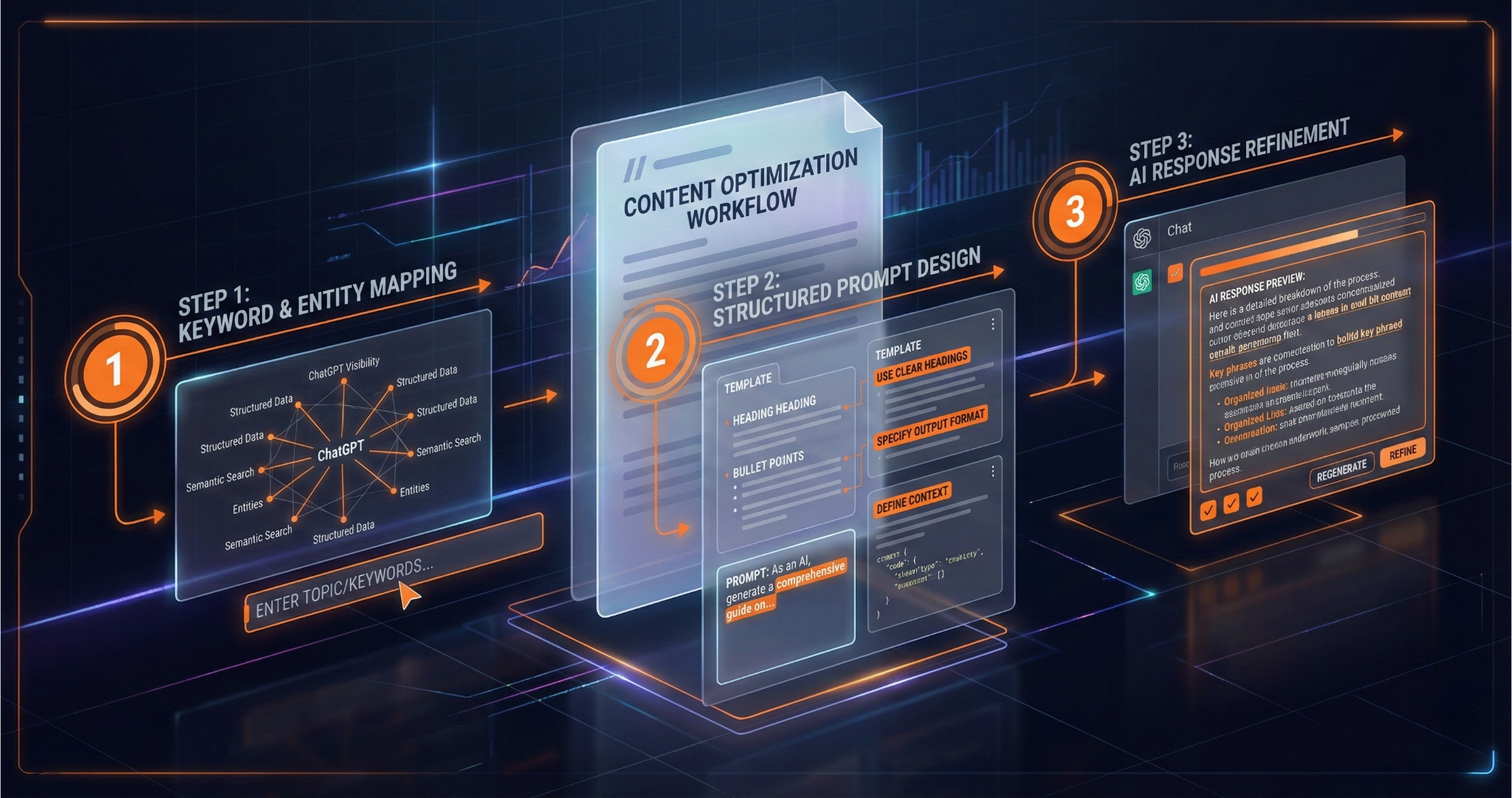
Optimising content for ChatGPT visibility starts with making your expertise easy for LLMs to interpret, verify, and reference. The goal is not to write for algorithms but to create authoritative, well-structured content that reinforces your credibility everywhere AI looks.
Here’s a simple process to optimize your website for LLMs:
Start with the direct answer: Open each page or section with the clearest possible answer to the main question. LLMs prioritize pages that immediately address user intent.
Use clear subheads and short sections: Break down complex topics into scannable segments. This helps LLMs map meaning more accurately.
Add one-sentence takeaways and definitions: These “extractable nuggets” often get quoted because they’re easy for LLMs to lift and reuse.
Cite credible sources and add expert attribution: Transparent sourcing improves trust signals, one of the strongest factors in LLM visibility.
Support your content with consistent external mentions: Guest posts, interviews, press features, and Reddit contributions all strengthen your authority footprint.
A Reddit user, growthcraftagency, summarised it well:
“Focus on creating authoritative content and building solid rankings, and you’ll naturally show up in ChatGPT results. Also, don’t overlook Reddit since ChatGPT often pulls insights from discussions there, so being active and adding value in relevant threads can give you an extra edge.”
How to Track Your ChatGPT Visibility
Since traditional SEO tools can’t measure LLM activity, you need a combination of AI-specific tools and indirect indicators.
Here’s how to track it effectively:
Use AI visibility tools: These tools show where your brand appears across ChatGPT answers and how frequently.
Check branded search growth: Look for increases in branded keywords inside Google Search Console. Many users search for a brand only after seeing it mentioned in ChatGPT.
Monitor AI-referred traffic: Filter traffic sources in Google Analytics that contain “GPT.” These signals show when users land on your site after engaging with AI-generated answers.
Review ChatGPT responses manually: Run common prompts in ChatGPT (e.g., “best [your niche] companies”) to see whether your brand appears and how it’s described.
LLM Optimization Tools and Services to Explore
If you want to improve LLM Content Optimization for ChatGPT Visibility, several tools and services can help you understand how AI systems interpret your brand and what you should adjust. Some of the best tools for LLM optimization are:
Peekaboo: Peekaboo shows where your brand appears across ChatGPT, Gemini, and Perplexity results, giving you a quick view of your AI search presence. But it focuses mainly on surface-level visibility, so it doesn’t explain why certain changes happen or how to improve them.
Keyword.com’s AI Visibility Tracker: Keyword.com helps you measure brand mentions, visibility patterns, and sentiment trends across AI-generated answers. It’s useful for high-level monitoring, but it doesn’t offer deeper insights into how LLMs interpret your content or what to fix.
Ahrefs Brand Radar: Ahrefs Brand Radar highlights GPT ranking trends and competitor comparisons that show where your brand stands in AI search. Its insights are strong on competition but limited when it comes to understanding trust signals or LLM comprehension.
Perplexity Analytics: Perplexity Analytics gives prompt-level visibility data that helps you understand how often your brand is cited in its model’s answers. However, its view is limited to Perplexity’s ecosystem, so it won’t give you a complete cross-LLM perspective.
If you want more than tracking, Total Authority gives you clear insight into how AI sees your brand and what to improve next. Get an AI Visibility Audit and start strengthening your presence in ChatGPT.
Frequently Asked Questions (FAQs)
Here are answers to the most common questions brands have about LLM Content Optimization for ChatGPT Visibility and how AI systems interpret online content:
Does Metadata Affect LLM Content Visibility in ChatGPT?
Yes. Clean, accurate metadata helps ChatGPT understand what your page is about. While LLMs don’t rely on metadata the way Google does, titles, descriptions, and schema markup give models a clearer context, improving how reliably they interpret and reference your content.
Clean metadata strengthens LLM SEO by making your content easier for AI to interpret.
What Role Do Keywords Play in LLM Optimization for ChatGPT?
Keywords matter, but not in the traditional SEO sense. LLMs focus on meaning, not density. Use precise, descriptive phrases that match how people naturally ask questions.
This helps the model connect your content to real prompts, improving your SEO for LLM without sounding keyword-heavy or forced.
How Frequently Should LLM Content Be Updated for Better Visibility?
Update your content whenever information becomes outdated or when new data emerges. LLMs pick up on inconsistencies quickly, and old data reduces trust.
Regular updates, like new stats, clearer explanations, and refreshed examples, support ongoing LLM SEO optimization and help ChatGPT reference your content more confidently.
What Are Common Mistakes in LLM Content Optimization for ChatGPT Visibility?
Common mistakes include inconsistent brand information, outdated claims, thin content, AI-rewritten text, and missing citations. These issues confuse LLMs and weaken trust signals.
Another mistake is skipping structured formatting, which makes content harder for models to interpret.
Can ChatGPT Prioritize Branded or Authoritative LLM Content?
Yes. ChatGPT tends to prioritize brands that show authority through consistent information, expert-backed content, and credible mentions across trusted sources.
Strong trust signals help LLMs understand that your content is reliable. This is an integral part of LLM optimization when using generative AI for SEO.
Improving your visibility in ChatGPT starts with the basics: clear content, consistent information, and strong signals that show AI exactly who you are and why your expertise matters. When LLMs can interpret your pages easily, they’re far more likely to include your brand in the answers people rely on.
That’s where Total Authority helps. Our AI Visibility Audits show how LLMs understand your brand, what’s missing from your trust signals, and what you can adjust to strengthen your presence across AI search.
Want to understand how AI sees your brand and what you can do to improve it? Get an AI Visibility Audit from our team at Total Authority and start building the signals that matter.