
What Are Large Language Models (LLMs) and Why Marketers Should Care?
Discover how Large Language Models (LLMs) like ChatGPT and Gemini are disrupting search and why marketers must adapt. Learn about Generative Engine Optimization (GEO), E-E-A-T, and how to build brand authority in an AI-driven answer economy.
The ground beneath the digital marketing world is shifting. For two decades, we’ve played a game defined by a single, dominant force: the Google search algorithm. We learned its language of keywords, backlinks, and domain authority. We built entire industries around deciphering its secrets. But a new technology, one that speaks our language, is rewriting the rules. This technology is the Large Language Model (LLM), and it is the engine powering the most significant transformation in information discovery since the dawn of the internet.
For marketers, this isn’t just another trend to watch; it's a fundamental reshaping of the landscape. The very act of searching is evolving from a transactional query into a collaborative conversation. Your audience is no longer just looking for a list of blue links; they're asking for answers, solutions, and summaries from AI assistants. The question is no longer just "How do I rank on Google?" but "How do I become a trusted source for the AI?"
This article will guide you through this new frontier. We will demystify what LLMs are, explore the new disciplines of LLM Optimization (LLMO) and Generative Engine Optimization (GEO), and provide a strategic playbook for ensuring your brand’s voice is not just heard, but amplified in the age of AI.
The New Search Paradigm: Understanding LLMs and Generative Engines
To navigate this new world, we first need to understand its core components. The familiar search engine is giving way to something more dynamic: the generative engine.
What are Large Language Models (LLMs)?
At its heart, a Large Language Model is a sophisticated AI trained on a colossal amount of text and data from the internet. Think of it as a digital brain that has read trillions of words from books, articles, websites, and research papers. Through this immense training, it hasn't just memorized information; it has learned the patterns, context, nuance, and structure of human language.
This allows it to do remarkable things: answer complex questions, write essays, summarize long documents, translate languages, and even generate computer code. When you interact with a chatbot like ChatGPT, Google's Gemini, or Perplexity, you are communicating with an LLM. It's not just retrieving a pre-written answer; it's generating a new, unique response based on its understanding of your query and the vast knowledge it possesses.
From Search Engines to Answer Engines: The Rise of GEO
This shift from retrieval to generation is changing user behavior. Why click through ten blue links to piece together an answer when an AI can synthesize the information and present it to you in a neat, conversational package? This is the rise of the "answer engine," and with it comes a new set of optimization principles.
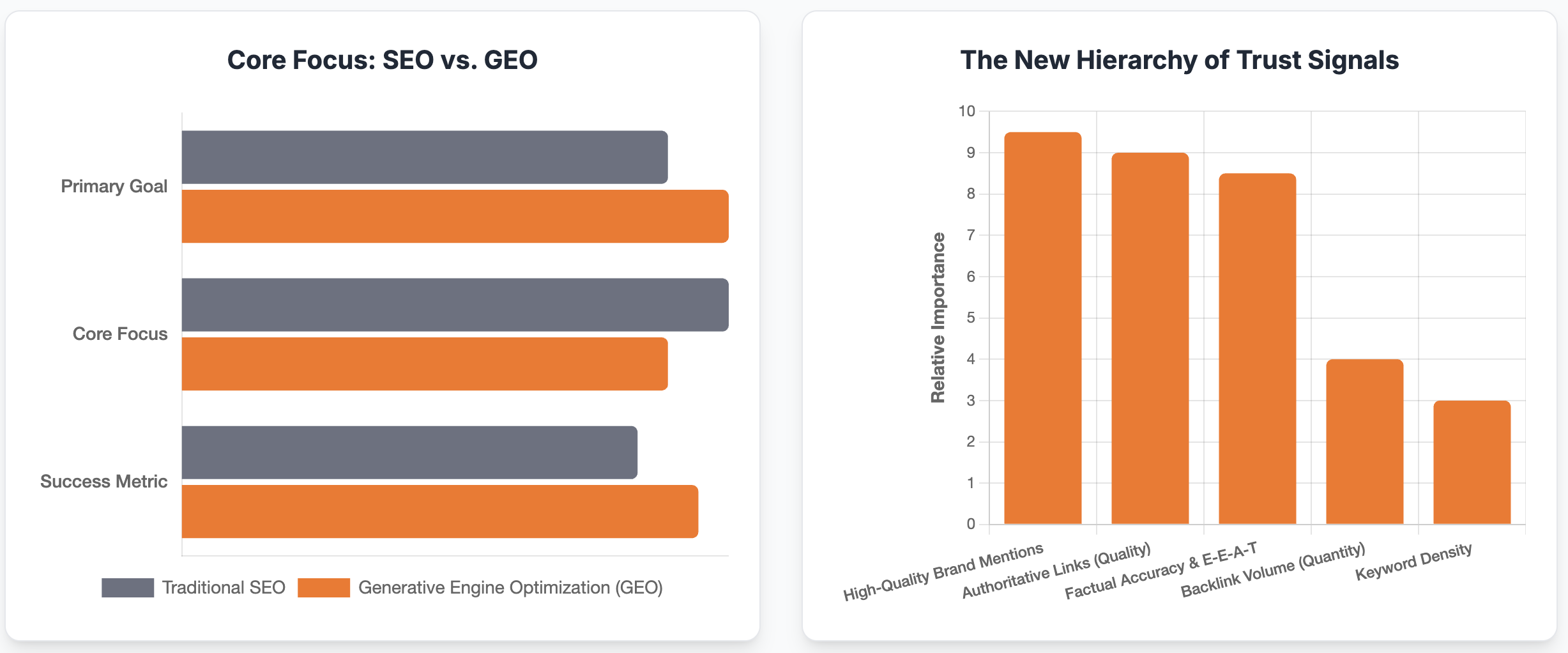
While the acronyms might seem like a new alphabet soup, they represent a crucial evolution from traditional SEO:
LLM Optimization (LLMO) or Large Language Model Optimization: This is the specific practice of making your content easily discoverable, digestible, and credible for Large Language Models. It’s about ensuring the AI views your information as a reliable source worth citing.
Generative Engine Optimization (GEO): This is a broader term, analogous to SEO. It encompasses all the strategies used to increase visibility within generative AI platforms, whether that’s Google’s Search Generative Experience (SGE), Perplexity, or other AI-powered answer engines.
AI Optimization (AIO): This is an umbrella term that covers the entire spectrum of optimizing digital assets and marketing strategies for an AI-first world.
The fundamental goal is moving from ranking to being the source.
Beyond Keywords: The Pillars of LLM Visibility
To succeed in GEO, we must fundamentally change how we think about being "found." LLMs don't just "crawl" your site for keywords. They evaluate your content within the broader context of the entire internet, assessing its credibility and authority in a way that is far more sophisticated than traditional algorithms. Two concepts are paramount here: E-E-A-T and the Knowledge Graph.
Read: What Is LLM Visibility and Why It Matters for Your Brand
E-E-A-T: The Currency of Trust in the AI Era
E-E-A-T, which stands for Experience, Expertise, Authoritativeness, and Trustworthiness, has been part of Google's guidelines for years, but it has become the absolute bedrock of LLM Optimization. An LLM's primary goal is to provide accurate and reliable answers. Therefore, it is programmed to seek out and prioritize sources that demonstrate these four pillars.
Experience: Does the content demonstrate real-world, first-hand experience? For a product review, this means showing the product was actually used. For a financial guide, it might mean it was written by someone with a long history in the industry.
Expertise: Is the content created by a subject matter expert? This is signaled by author credentials, publications in respected journals, and a history of creating high-quality content on the topic.
Authoritativeness: Is your brand or website recognized as a go-to leader in its field? This is built over time through consistent, high-quality output and, crucially, by being cited and mentioned by other authoritative entities.
Trustworthiness: Is your information accurate, reliable, and secure? This involves everything from citing your sources and having clear contact information to maintaining a secure website (HTTPS).
For an LLM, a website that strongly exhibits E-E-A-T is not just another data point; it's a trusted node in its network of knowledge.
Becoming an "Entity" in the Knowledge Graph
An LLM's understanding of the world is often structured around a "Knowledge Graph"—a vast, interconnected web of entities (people, places, organizations, concepts) and the relationships between them. Being a clearly defined "entity" in this graph is like being a recognized landmark on a map.
When an LLM sees your brand name mentioned across multiple trusted sources—news articles, industry reports, academic papers, and other authoritative websites—it solidifies your brand as a significant entity. This recognition makes it far more likely that the LLM will turn to your official website as the definitive source of information about you and your area of expertise.
The Playbook for LLM Optimization (LLMO)
So, how do you actively optimize for this new reality? It's a holistic process that blends content strategy, technical precision, and a modern approach to brand authority.
1. Content: From Keywords to Concepts
The core of your strategy must be exceptional content, but the focus shifts from hitting keyword targets to covering topics with unparalleled depth and clarity.
Prioritize Factual Accuracy and Verifiability: In an era of AI-generated content, provable facts are gold. Back up claims with data, cite credible sources, and link out to studies and research. This demonstrates trustworthiness to both human readers and AI evaluators.
Embrace Natural Language: Write for a human asking a question. Structure content around answering the "who, what, where, when, why, and how." FAQ sections, "how-to" guides, and detailed explanations that directly address user intent are incredibly valuable. Think about the entire conversational journey a user might have and create content that serves every stage.
Leverage Structured Data (Schema Markup): Schema markup is a code vocabulary that you add to your website to explicitly tell search engines and LLMs what your content is about. It's like adding name tags to everything on your page. By using schema to identify your organization, authors, articles, products, and events, you remove ambiguity and make it effortless for an LLM to parse, understand, and trust your information.
2. Authority: Becoming a Source of Truth with Digital PR
This is where the most significant strategic shift occurs. For years, SEO has been obsessed with link building—the sheer volume of websites linking back to a page. In the world of GEO, the game is no longer about quantity but about the quality and context of your mentions. This is the domain of Digital PR.
Digital PR focuses on earning high-quality media coverage, expert features, and brand mentions in reputable, authoritative publications. It's about generating genuine buzz and becoming part of the industry conversation.
Brand Mentions are the New Backlinks: An LLM understands that when a major news outlet, a leading university, or a respected industry publication mentions your brand—even without a hyperlink—it is a powerful vote of confidence. This unlinked mention is a strong signal of authority and relevance. The AI reasons that if these trusted entities are talking about you, you must be important.
Quality Over Quantity in Link Building: This doesn't mean links are dead; it means their purpose has evolved. A single, contextually relevant link from a highly authoritative and topically relevant site is now exponentially more valuable than hundreds of low-quality links from directories or spammy blogs. The goal of link building should be to acquire endorsements from the most trusted voices in your field.
This chart illustrates the strategic shift in off-page optimization priorities for the generative era. While all signals have some value, the emphasis has decisively moved towards high-quality, earned authority.
Think of it this way: Digital PR is how you build your E-E-A-T profile across the web. Each piece of earned media, each expert quote in a trade publication, and each data-driven report that gets cited by others is another reason for an LLM to view your brand as a pillar of trust and authority.
The Future is Conversational
The integration of generative AI into our digital lives is not a passing phase. It is the beginning of a new, more conversational, and more intuitive internet. Over time, these systems will become more personalized, multimodal (understanding images, video, and audio), and seamlessly woven into the devices we use every day.
Trying to find short-term "hacks" to trick these systems is a losing game. The algorithms are too sophisticated and learning too quickly. The only sustainable, future-proof strategy is to align with their core objective: providing users with trustworthy, expert, and helpful information.
Marketers who see this shift as a threat will be left behind. But those who see it as an opportunity have a chance to build something more valuable and enduring than a #1 ranking. They have the opportunity to build real authority, to become a genuine source of truth, and to forge a deeper, more meaningful connection with their audience by simply being the best, most helpful answer to their questions. The time to start building that trust is now.
Get Your LLM Visibility Audit
Discover how visible your brand is across AI platforms