
LLM SEO: Is There Such a Thing as Optimizing for AI Answers?
Explore LLM SEO and how to optimise for AI answers in the era of generative search. Learn strategies for AI optimisation, Generative Engine Optimisation, E-E-A-T, digital PR, and link building to secure AI citations, boost authority, and future-proof your SEO strategy in Google’s Search Generative Experience.
The Dawn of a New Search Era
The digital marketing landscape is in the midst of a seismic shift, a transformation driven not by a new social media platform or a subtle algorithm update, but by the very way we seek and receive information. The rise of Large Language Models (LLMs) like Google's Gemini and OpenAI's ChatGPT is fundamentally reshaping the user's journey. Instead of a list of blue links, users are increasingly presented with a single, definitive, AI-generated answer. This new reality has given birth to a new discipline, a new frontier for optimization: LLM SEO. But is it a tangible strategy or just a new buzzword for old practices?
The question on every CMO's, SEO specialist's, and digital PR strategist's mind is no longer just "How do we rank on Google?" but "How do we become the source for the AI's answer?" This is not merely an evolution of search; it is a redefinition of digital authority. It’s a world where being cited in an AI-generated paragraph could become more valuable than a number one ranking. This article delves deep into the mechanisms of AI answers, explores the concrete strategies of LLM SEO, and investigates the critical, often underestimated, role of digital PR and link building in achieving visibility in this new paradigm.
The Engine Behind the Answer: How LLMs Think
To influence AI, one must first understand how it "thinks." An LLM-powered answer is not pulled from thin air. It's a sophisticated tapestry woven from two primary threads: its foundational training data and real-time, curated information.
The Two Brains of an LLM
The Knowledge Base (Training Data): At its core, an LLM is built upon a colossal dataset of text and code from the internet. This static, pre-existing knowledge forms its base understanding of language, concepts, and relationships. It’s the source of its fluency and broad contextual knowledge. However, this data has a cut-off date, making it inherently outdated for current events or rapidly evolving topics.
The Live Web Retriever (Retrieval-Augmented Generation - RAG): To overcome the limitations of their static training, modern AI search applications employ a system called Retrieval-Augmented Generation (RAG). When a user asks a question, the RAG system performs a real-time search of a curated index of the live web. It finds the most relevant, authoritative, and timely web pages, then feeds this fresh information to the LLM. The LLM then uses this retrieved data to formulate a comprehensive, up-to-date, and cited answer.
This dual-system architecture is the key. LLM SEO isn't about gaming a static algorithm from 2021; it's about making your content the most logical, authoritative, and compelling choice for the RAG system to retrieve right now.
Defining LLM SEO: The Core Tenets of Optimizing for AI
LLM SEO, sometimes called Generative Engine Optimization (GEO), is the practice of creating, structuring, and promoting content in a way that increases its likelihood of being discovered, understood, and cited by an LLM in its generative answers. While it shares a foundation with traditional SEO, its focus is more acute. It’s less about keywords and more about concepts, less about rankings and more about becoming a trusted entity.
Key Optimization Strategies
Radical Clarity and Factual Accuracy: LLMs are designed to synthesize information and present facts. Vague marketing fluff is easily dismissed. Content must be direct, unambiguous, and scrupulously fact-checked. Use clear headings, simple language, and present data points directly. Answer the question your user is asking with the precision of a subject matter expert.
Embrace E-E-A-T (Experience, Expertise, Authoritativeness, and Trustworthiness): If E-E-A-T was important for traditional SEO, it is the absolute bedrock of LLM SEO. The AI's RAG system is actively looking for signals of trust. This means content should be written by credible authors, published on reputable sites, and supported by evidence. Author bios, "About Us" pages, and clear sourcing are no longer just best practices; they are vital trust signals for machines.
Structure for Machines, Write for Humans: Structured data, like Schema markup, is essential. It provides a clear, machine-readable summary of your content, making it easier for the RAG system to understand key information like who wrote the article, what the company does, or the specifics of a product. Use FAQ schema, How-to schema, and other relevant types to spoon-feed information to the AI.
Be a Definitive Source: Instead of writing ten surface-level articles on a topic, create one comprehensive, in-depth pillar page that covers the subject from every angle. Include original research, data, and unique insights. The goal is to create a resource so thorough that the AI views it as a primary source of truth.
Digital PR and Link Building: The Unseen Hand Guiding AI
If high-quality, structured content is the bait, then digital PR and link building are the rod and reel that place it in the right part of the river. In the context of LLM SEO, the authority passed by backlinks and media mentions is not just about search rankings; it's about telling the AI which sources the human world already trusts.
An LLM's RAG system doesn't just look for content; it looks for validated content. A backlink from an authoritative, relevant website is a powerful vote of confidence. A mention in a major news publication is an even stronger signal. These are not just links; they are third-party validations that your content is credible.
From Backlinks to AI Citations
The new currency of success is the "AI Citation." This is when an LLM directly references and links to your webpage as the source for the information it provides. Earning these citations requires a profound level of authority, an authority that is built, in large part, through a sophisticated digital PR and link-building strategy. When a high-authority news site, industry publication, or academic institution links to your content, it creates a ripple effect, elevating your perceived trustworthiness in the eyes of the AI's retrieval system.
This makes digital PR more critical than ever. Securing placements in earned media isn't just for brand awareness anymore. It's about strategically placing your brand's expertise into the very publications and websites that AI models are trained on and are most likely to retrieve in real-time.
Key Statistics on AI Sourcing and Search Impact
These numbers paint a stark picture: AI relies on trusted, journalistic sources. Without a strong digital PR footprint, your brand's expert content is unlikely to be found, let alone cited.
LLM Seeding: Proactive Placement in AI Training Grounds
Beyond traditional media, AI models learn a great deal about real-world consensus, opinions, and product recommendations from user-generated content (UGC) platforms. LLM Seeding is the practice of strategically publishing and participating on these platforms to "seed" them with high-quality, branded information that LLMs are likely to scrape, summarize, and cite.16
Analysis of AI source preferences reveals that these UGC hubs are a dominant part of the AI's information diet. For Google AI Overviews, Reddit is the single most-cited source, accounting for 21% of citations. It is followed by YouTube (19%) and Quora (14%). These platforms are where LLMs go to find answers to niche questions and to understand what real people think about products, services, and brands.
The strategy for LLM seeding is not to spam these platforms with promotional content. This would be counterproductive and likely violate community guidelines. Instead, the goal is to engage authentically by:
Providing genuinely helpful, expert-level answers to questions in relevant subreddits or Quora spaces.
Participating in discussions to add value and demonstrate expertise.
Creating high-quality video content on YouTube that answers common questions or provides tutorials.
The objective is to become a recognized and trusted voice within these communities. When other users begin to upvote, reference, and quote a brand's contributions, it creates a powerful signal of community-validated authority that AI systems are designed to detect.
This reveals a bifurcated sourcing strategy employed by AI models. For factual, news-driven queries, they defer to the top-down authority of established journalism. For subjective, opinion-based, or recommendation-seeking queries, they defer to the bottom-up, consensus-driven authority of community platforms. Therefore, a comprehensive digital PR strategy for GEO must operate on both fronts simultaneously, targeting high-authority media for factual credibility and engaging deeply in community platforms to build social proof and subjective authority.
The following table provides a comparative analysis of the source citation preferences for major AI platforms, offering a tactical guide for allocating PR and content seeding resources.
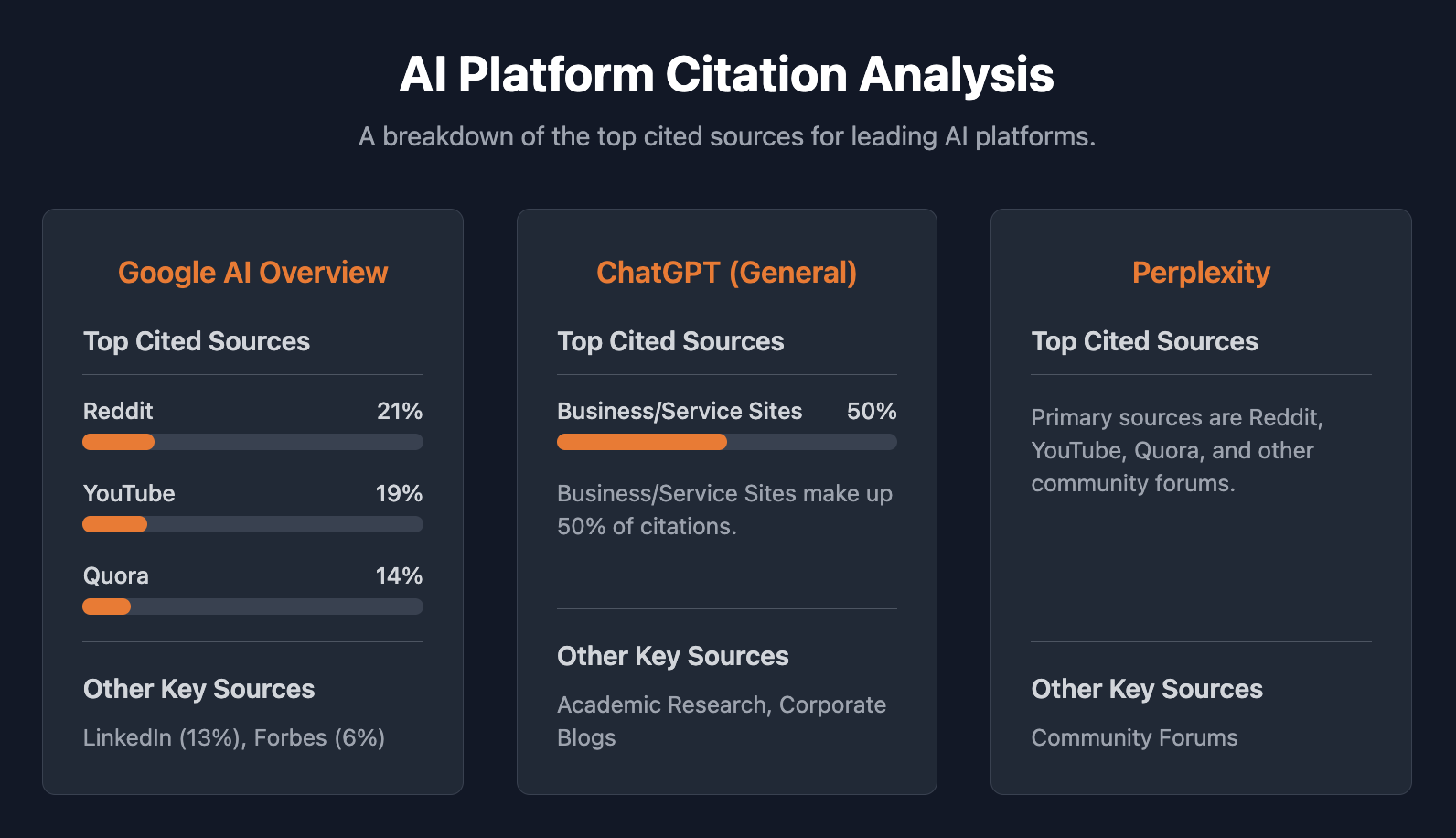
This platform-specific data transforms a vague strategic goal ("increase LLM visibility") into a set of precise, justifiable tactical plans. A brand whose audience primarily uses Google Search must have a robust strategy for Reddit and YouTube. A B2B brand whose customers are more likely to conduct research using ChatGPT must prioritize securing mentions in top-tier business press and ensuring its own website content is exceptionally comprehensive and authoritative. This data enables a targeted allocation of resources to the channels that will have the greatest impact on visibility for a specific platform and audience.
The Challenges and Realities of LLM SEO
Despite its promise, LLM SEO is not a silver bullet. The field is nascent, and significant challenges remain.
The 'Black Box' Problem: The precise weighting of signals within AI retrieval systems is proprietary and constantly changing. What works today might be less effective tomorrow, making it a difficult process to reverse-engineer with certainty.
The Speed of Evolution: The technology is advancing at an exponential rate. New models and architectures are released continuously, requiring strategies to be fluid and adaptable.
The Risk of 'Model Collapse': There is a theoretical risk that as AI models increasingly train on AI-generated content, they could enter a feedback loop that degrades the quality and diversity of information, a phenomenon known as "model collapse." Optimizing purely for the machine could inadvertently contribute to this problem.
The Future of Visibility is Human-Centric
Ultimately, optimizing for AI answers is a fascinating paradox. The best way to appeal to these complex machines is to double down on the most human-centric qualities of your content: expertise, trustworthiness, clarity, and genuine value. The AI is designed to find and reward the very best of what the web has to offer.
LLM SEO is real, and its importance will only grow. It requires a holistic approach that blends technical precision (structured data), content excellence (E-E-A-T), and reputational authority (digital PR and link building). The brands that will win in this new era are those that stop chasing fleeting algorithm hacks and start building a lasting legacy of knowledge. They will focus on becoming an unimpeachable source of truth in their niche—so clear and authoritative that both humans and their AI assistants can't help but listen.
Get Your LLM Visibility Audit
Discover how visible your brand is across AI platforms