We Asked ChatGPT to Recommend a Realtor in Every State. It Named 234 in Houston and 9 in West Virginia
A controlled test of how AI answers the most commercially loaded question in residential property. Across all 50 states and DC, AI recommendation concentration varies 26-fold - and AI offers the least choice exactly where consumers already have the fewest options. With an interactive 50-state map, the full methodology and the limitations stated up front.
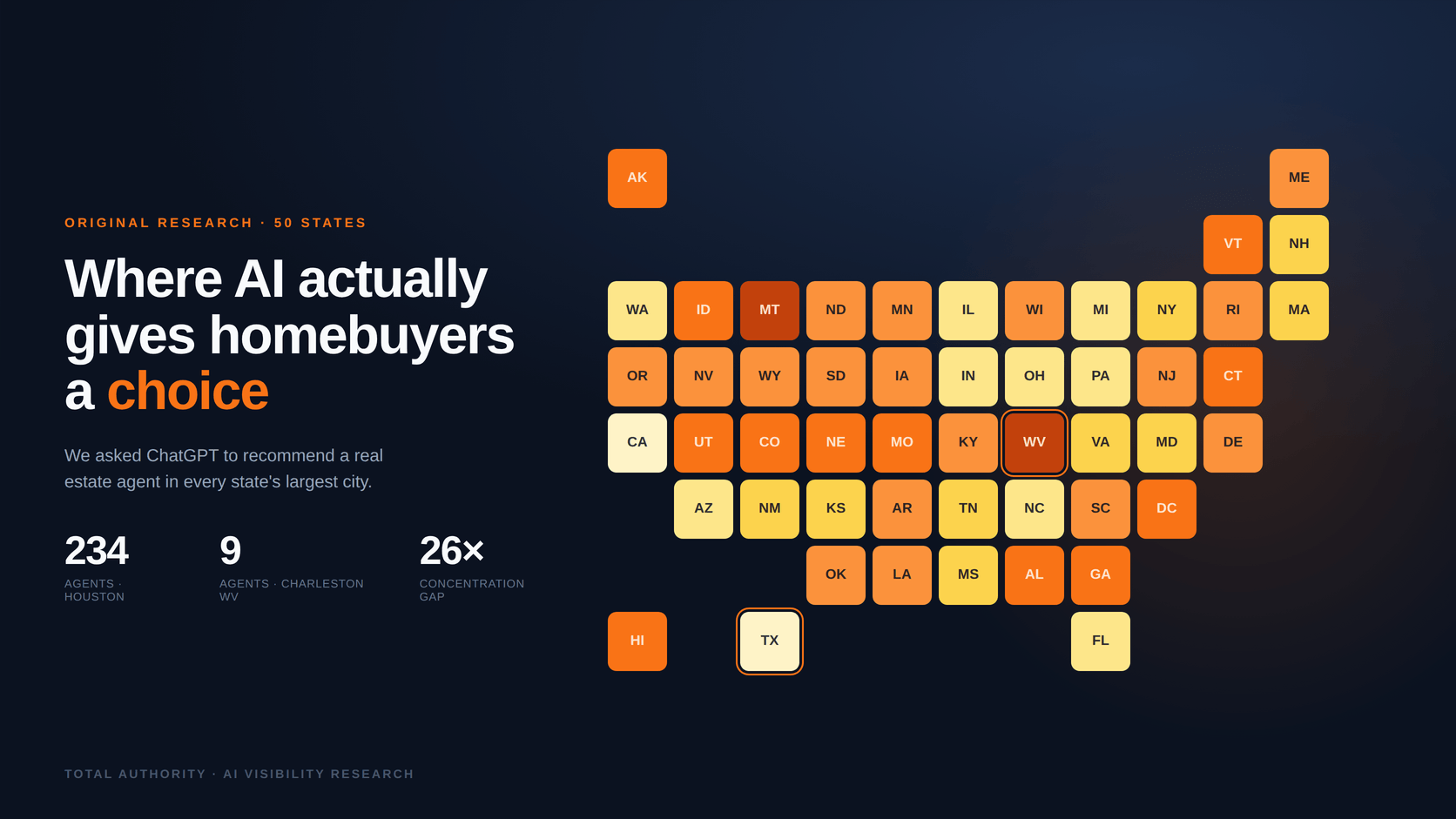
We asked ChatGPT to recommend a real estate agent in the largest city of all 50 states and the District of Columbia. In Houston it named 234 different agents. In Charleston, West Virginia, it named nine. That 26-fold gap is the finding, and it points somewhere more uncomfortable than the usual worry about AI monopolies.
The fear about AI recommendations is that they will collapse choice — that a handful of well-optimized operators will capture the answer and everyone else will disappear. In large markets, that is not what happens. ChatGPT named hundreds of agents in Los Angeles and Houston, spreading its recommendations so thinly that no single name held even 3% of them.
The problem is at the other end. AI offers the least choice exactly where consumers already have the fewest options. Nine agents for an entire state capital. And the agents it does name repeatedly share one measurable trait — which we will come to, because it is not the one the industry assumes.
The 50-state picture
We measured concentration using the Herfindahl-Hirschman Index, the same statistic US antitrust regulators use to judge whether a market is competitive. It is the sum of every participant's squared percentage share, so it rises sharply when a few names take most of the attention. Regulators treat anything under 1,500 as an unconcentrated market.
Applied to AI recommendations rather than transactions, the range across the country runs from 53 to 1,400.
AI Recommendation HHI by state, from ChatGPT's answers in each state's largest city. Click any state. Note that land area is not evidence: we sample one city per state, so Texas and Rhode Island rest on exactly the same amount of data.
AI Recommendation HHI measures how concentrated ChatGPT's recommendations were within our controlled prompt set, not real-world transaction market share. Names are what the model returned from cited sources — not a Total Authority ranking or endorsement, and individual agents were not separately verified. US antitrust guidelines treat an HHI below 1,500 as an unconcentrated market. Boundaries: US Census Bureau, Albers projection with Alaska and Hawaii inset.
Read that map and the pattern is unmistakable: concentration tracks how many agents exist to name. It is not about geography, politics or regional culture. Houston returned 234 distinct agents and an HHI of 53 — as close to perfectly diffuse as a real market gets. Charleston, West Virginia returned nine agents and an HHI of 1,400, approaching the threshold at which antitrust regulators start paying attention.
Montana's largest city, Billings, produced eleven agents. Honolulu and Kansas City produced fifteen each. In those markets, being one of the names AI knows is worth a great deal, because the list is short enough to matter.
This is the practical asymmetry. In Los Angeles, winning AI visibility means joining a crowd of 258. In Billings, it means being one of eleven — which is both a far larger prize and a far more achievable one.
Turn off web search and the recommendations vanish entirely
The most revealing result in the study is the one that produced no data at all.
We ran 75 tests with web search disabled. ChatGPT named zero agents in all 75, declining every time on accuracy grounds. We ran 75 with search enabled. It named agents in 73 of them and cited its sources.
The model is not recalling agents from training. It is looking them up, and when it cannot look them up it says so.
This reframes the entire problem. A real estate agent's AI visibility is not stored in the model's weights, waiting to be recalled. It is assembled at query time from whatever the retrieval layer can find. You are not trying to be memorized. You are trying to be findable at the moment someone asks.
Which raises the obvious question: findable where?
The gatekeepers are not other agents
Every recommendation in the study carried the sources the model retrieved to produce it. Across 6,077 citations, ten domains accounted for 37% of everything ChatGPT read.
Share of all 6,077 citations captured across the study. Portals and directories dominate; individual agent websites are almost absent from the top of the list.
Bars are scaled to the largest share, not to 100% of citations. The remaining 63% is distributed across a long tail of individual sites.
Not one of those ten is an individual agent's website. They are portals, brokerages, directories and trade rankings — the infrastructure of the industry rather than its practitioners.
The consequence is blunt. An agent absent from Zillow, Realtor.com and the ranking sites is largely invisible to the layer AI answers from, no matter how good their own website is. A beautifully built personal site that nothing else links to is a beautifully built personal site that AI has no reason to encounter.
This is the same mechanism we found in a different sector entirely. Our crawl of 3,942 med spa pages showed that businesses AI never cited were technically indistinguishable from cited ones — crawl accessibility of 94.1 against 94.6. What separated them had nothing to do with their own website's mechanics. Two industries, same lesson: the work is off your site as much as on it.
There is no such thing as "the AI recommendation"
Then there is the finding that should give pause to anyone selling AI visibility, including us.
We put identical prompts to ChatGPT, Gemini and Claude across twenty cities. Mean overlap between any two models' top-five lists was 9.2%. In 16 of the 20 cities, no single agent appeared in all three models' top five.
Identical prompts, same twenty cities, top-five agent lists compared pairwise.
Being ChatGPT's top result tells you almost nothing about how Gemini or Claude will answer. Any vendor — us included — who tells you they have made you "the AI recommendation" for your city is describing one model on one day. Ask which one, and ask what the other two said. Doing this properly means tracking visibility across platforms on a fixed prompt set rather than screenshotting a good day.
It also means the map above should be read for what it is: ChatGPT's view of the country, not AI's. We say so plainly because the 9.2% figure is our own, and it constrains our own headline.
What the repeatedly-recommended agents have in common
We took the agents ChatGPT named five or more times and compared them against the agents it named exactly once, using the SEO metrics their own websites carry. Twenty-five in each group, agents with their own domain only.
Medians. Mann-Whitney U, one-sided. n = 25 per group.
Domain Rating
2.9× · p = 0.0013
Referring domains
1.3× · p = 0.0006
Organic traffic / mo
7.7× · p = 0.049
Repeatedly-recommended agents carry roughly three times the Domain Rating and nearly eight times the organic traffic. That is the headline, and it is real.
But look at which column is actually the strongest signal. It is not Domain Rating, and it is not traffic. It is referring domains — the count of distinct websites that mention you — with a p-value of 0.0006, the most statistically reliable result in the table despite the smallest ratio.
The effect size is modest. The confidence is not. Breadth of mention beats depth of authority: being talked about in many places matters more than being powerful in one. It is the difference between citation rate and mention rate, and it is why we measure both. That is consistent with what we found in our earned media study, where placements and AI citations correlated at a Spearman ρ of 0.58 and every business with five or more placements was cited.
Authority is neither necessary nor sufficient
Here is the part that complicates the tidy story.
One agent with a Domain Rating of 4.3 and 85 monthly visitors was recommended 19 times. A national brokerage with a Domain Rating of 71 and 12,838 monthly visitors was named once.
Twelve per cent of the repeatedly-recommended group have a Domain Rating under 10. Twelve per cent of the named-once group have one above 40. So high authority is not required to win, and it does not guarantee anything either.
Three things follow for anyone working in a local market:
- A small site can win. AI visibility is not simply a re-run of the SEO leaderboard, which is genuinely good news if you are not at the top of it.
- Being big does not buy inclusion. High-authority national brands were routinely named once and then not again.
- Distribution beats domain power. If you have to choose between one more strong link and five more places that mention you by name, the data points at the five.
What we would actually do with this
If you are a real estate firm selling property in a market like Billings or Charleston, the shortlist is short and the opportunity is correspondingly large. Get onto the properties that AI is demonstrably reading: a complete Zillow profile, Realtor.com, the directories that keep appearing in the citation data, and the trade rankings that carry disproportionate weight for their size. RealTrends alone accounted for more citations than seven of the ten largest sources. This is digital PR working on the citation layer rather than link building in the old sense.
Then make yourself nameable. Every agent in the repeatedly-recommended group had one thing the retrieval layer could latch onto — a name attached to a place, stated the same way across many sites. That is entity work, and it is cheap compared with the alternative.
What we would not do is buy a claim about "ranking first in AI". The 9.2% cross-model overlap makes that claim close to meaningless without a stated model, a stated prompt set and a stated date.
How the study was run
The largest city in each of the 50 states plus the District of Columbia, drawn from US Census ACS 5-year data (2023 vintage). One uniform selection rule for every state, so Cheyenne and New York are measured identically.
Fifteen prompts across four intents — generic, seller, buyer and specialty — frozen and SHA-256 hashed before collection began, so no prompt could be tuned mid-study. Each state was tested with a five-prompt core subset spanning all four intents. Requests were independent and stateless with web search enabled, using structured JSON output so parsing introduces no variance. The model was never shown candidate names and never told what a good answer looks like.
Refusals were measured, not discarded. The response schema lets the model decline inside the structure. Forcing a list of agents would make refusal inexpressible and would actively push the model to invent names. Refusals stay in the denominator; only our own API failures are excluded. Dropping them would mechanically inflate every share we report — which is precisely how the search-disabled result would otherwise have disappeared.
Names were resolved to canonical entities before counting. Individuals, teams and brokerages are never merged with one another, and a shared portal domain is explicitly not treated as evidence that two names are the same person.
A correction we caught in pilot, because it is instructive. An earlier build merged entities on any shared domain. Because AI cites Zillow profiles so heavily, every agent with a Zillow page collapsed into a single entity — making one Cincinnati agent appear to hold 34.7% of the market against a true 13.3%, and naming the wrong market leader in four of five cities. The rule now requires an agent-owned domain, with regression tests to keep it that way. We mention it because a study that reports no problems during development is usually a study that was not checked.
What this study does not show
Stated plainly, so a reader can attack the report on the same grounds we already have.
- One city per state. The largest city stands in for the state. Rural and secondary markets are not represented, and state-level claims inherit that limit.
- One model for the map. The 50-state results are ChatGPT specifically. Given the 9.2% cross-model overlap, they should not be read as "what AI says".
- Small states rest on few observations. Charleston's HHI of 1,400 comes from nine agents. The direction is sound; the precise value needs more repetitions.
- Authority enrichment is partial. 76 domains carry Ahrefs data. States without it are shown as no data rather than as zero.
- Correlation, not causation. The SEO metrics are read at a single point in time. Authority may drive AI visibility, or both may follow real-world prominence. This study cannot separate them, and nothing here should be read as proving that buying links causes AI recommendations.
- A photograph, not a trend. Both AI answers and SEO metrics move.
- Existence not individually verified. Agent names come from the sources the model cited, but each named individual has not been separately confirmed to practise in that market.
Every observation records the study version, code commit, provider, model, prompt-set hash, request parameters, token usage, measured cost and a UTC timestamp. Requests are content-addressed, so a re-run reproduces the dataset without re-billing work already done.
The 51-row state-level dataset behind the map is published in full, under a CC BY 4.0 licence, as CSV and JSON. Every number in this article can be checked against it, and we would rather you did.
Collected 11 August 2026. Model under test: gpt-5.4-mini, web search enabled. Authority data: Ahrefs. Demographics: US Census ACS 5-year, 2023 vintage.
Frequently asked questions
Does AI recommend the same real estate agents to everyone?
No. In large markets it names hundreds — 234 distinct agents in Houston, 258 in Los Angeles, with no single name holding 3% of recommendations. Concentration rises sharply in smaller markets, reaching an HHI of 1,400 in Charleston, West Virginia, where only nine agents were named at all. Choice tracks how many agents exist to name.
How does ChatGPT decide which real estate agent to recommend?
It retrieves rather than recalls. With web search disabled, ChatGPT named zero agents across 75 tests, declining on accuracy grounds; with search enabled it named agents in 73 of 75 and cited sources. Those sources are dominated by portals and directories — Zillow alone accounted for 13.2% of 6,077 citations, and ten domains for 37%.
Do ChatGPT, Gemini and Claude recommend the same agents?
Rarely. Across twenty cities, mean pairwise overlap between any two models' top-five lists was 9.2%, and in 16 of the 20 cities no single agent appeared in all three. There is no single "AI recommendation" for a given city, which limits what any single-model visibility claim is worth.
Does a high Domain Rating get an agent recommended by AI?
It helps but does not decide. Agents named five or more times had a median Domain Rating of 29.0 against 10.0 for those named once. But one agent with a Domain Rating of 4.3 was recommended 19 times, while a national brokerage with a Domain Rating of 71 was named once. The strongest statistical signal was referring domains — the breadth of sites mentioning an agent — not domain power.
What is AI Recommendation HHI?
The Herfindahl-Hirschman Index applied to AI recommendations: the sum of each agent's squared percentage share of recommendations within our controlled prompt set. US antitrust guidelines treat an HHI below 1,500 as an unconcentrated market. It measures concentration of AI recommendations only, not real-world transaction market share.
About the Author
Chris Panteli is the founder of Total Authority and Linkifi, host of the Market Movers Pod, and an AI visibility researcher. His work focuses on repeatable methods for understanding brand discovery, citation and recommendation in AI answers.
Find out what AI says about your market
The agents in the repeatedly-recommended group are not guessing at their position — they can be measured. Grade a priority page free, or take the Real Estate AI Visibility Audit for a documented record of how every major AI platform describes your business, which competitors it names instead, and exactly which sources it drew on to decide.